LinkLens — self-hosted link intelligence and smart redirect engine
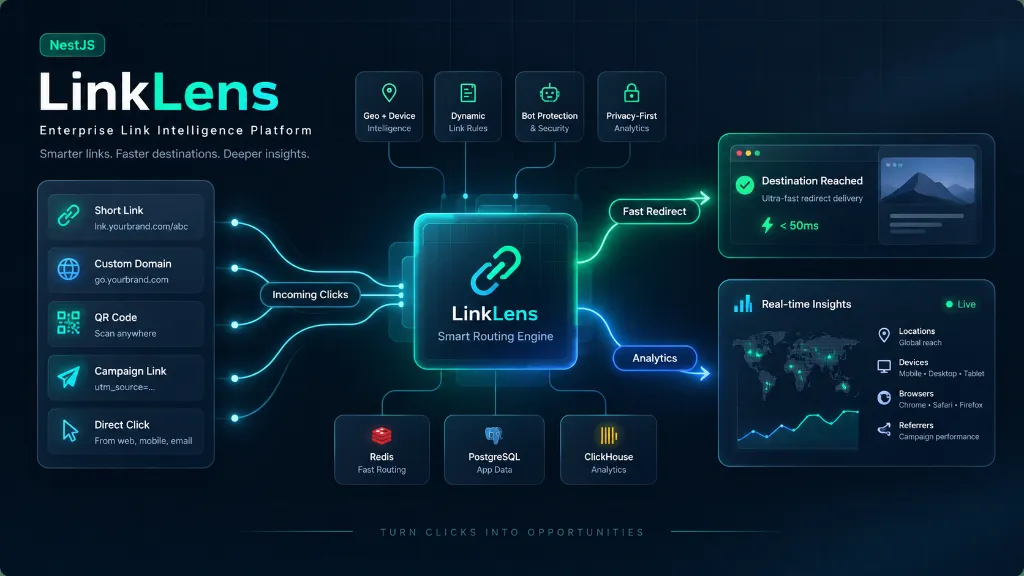
LinkLens is a self-hosted link management and redirect platform built with NestJS, Redis, ClickHouse and Next.js, separating a fast redirect path from asynchronous analytics.
The problem
Typical URL shorteners resolve every click against a transactional relational database and call paid third-party APIs for geolocation. Both become the bottleneck — in latency and in cost — as click volume grows.
LinkLens was designed so that the redirect itself never waits on the database or on analytics, and so that geo/device enrichment costs nothing per request.
Architecture and approach
- Hot path: link rules are resolved from Redis by the NestJS redirect engine, without querying PostgreSQL. The design target for this path is a single-digit-millisecond redirect.
- Cold path: each click is published to a BullMQ queue; a worker pool enriches it and stream-inserts it into ClickHouse, a columnar store suited to large analytical aggregations.
- Geo and device data come from local MaxMind .mmdb datasets and ua-parser-js evaluated in memory, so there is no recurring external lookup cost.
- Custom domains get TLS automatically: Caddy issues certificates on demand after validating the domain through a backend webhook, without server restarts.
Key features
- Rule-based routing by country, OS, browser, language or weighted A/B split.
- Analytics dashboards on ClickHouse aggregations, with UTM attribution and a live WebSocket activity feed.
- Workspace isolation with OWNER, ADMIN, MANAGER and ANALYST roles (RBAC).
- REST API documented with OpenAPI 3.0, SHA-256-hashed API keys with rotation, and HMAC-SHA256-signed webhooks.
- A GDPR mode that truncates IP addresses before they are persisted.
- SVG/PNG/PDF QR-code generation with logo overlays and styling.
Engineering decisions
- Split read path and write path: the redirect response never depends on analytics writes succeeding.
- Columnar storage (ClickHouse MergeTree ordered by workspace, link and month, with a 365-day TTL) for click telemetry instead of the relational database.
- Self-hosted enrichment data instead of a paid geo API, trading periodic dataset updates for zero per-request cost.
Technology stack
- Backend
- NestJS
- TypeScript
- Passport.js (JWT/OAuth)
- BullMQ
- Data
- PostgreSQL 16 (Prisma)
- Redis 7
- ClickHouse 24
- Frontend
- Next.js 14 (App Router)
- React 18
- Tailwind CSS
- TanStack Query
- Zustand
- Recharts
- Infrastructure
- Docker Compose
- Caddy 2 (on-demand TLS)