AI Agents Write 30% More Code. Teams Ship the Same Amount.
A Harvard study of 300 million work events across 718 firms found AI coding agents raise code output 30% while software delivery stays flat. The gains are absorbed by code review, and that changes what you should measure.

In this article (7 sections)
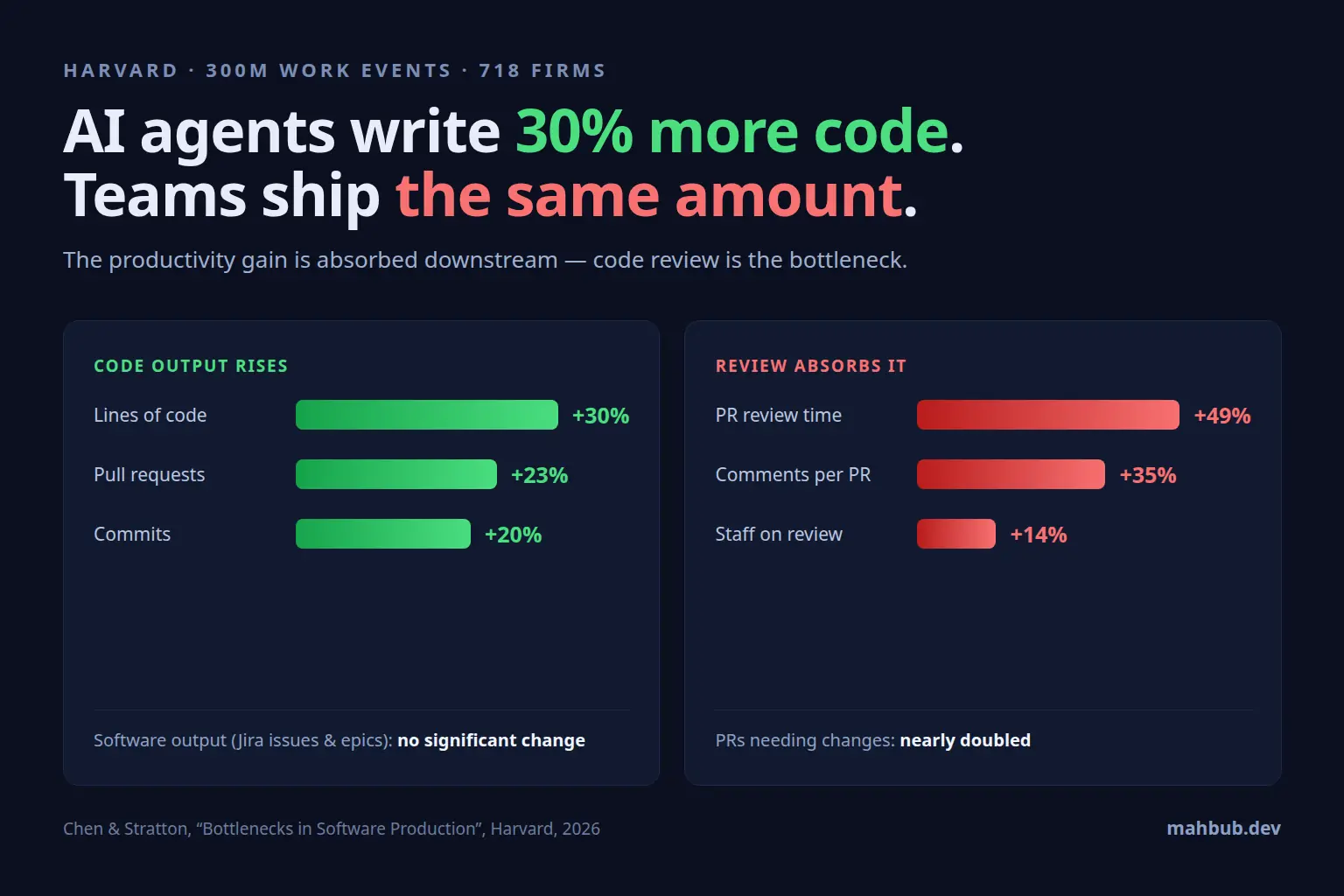
Teams adopting AI coding agents are generating far more code without shipping more software. In the largest study of this to date, Harvard researchers Fiona Chen and James Stratton analysed 300 million work events across 718 firms and found that after agent adoption, lines of code rose 30%, commits 20% and pull requests 23% — while the resolution rate for Jira issues and epics showed no statistically significant change.[1] The reason is that we sped up a stage that was never the constraint: code review absorbed the gains, with review time up 49%, the share of pull requests needing changes nearly doubling, and comments per pull request up 35%.[1] The fix is not to abandon agents but to move your attention downstream — measure cycle time at the review stage rather than commit volume, send deliberately smaller diffs, keep one human accountable for every change, and refuse to auto-accept edits you cannot explain. The rest of this post walks through each step and the evidence behind it.
Step 1: Understand what actually changed
AI assistants and agents are not the same intervention, and the data separates them cleanly.
AI assistants — autocomplete-style suggestions — produced modest effects: 12% more lines of code, 9% more commits, 5% more pull requests, and only the commits figure reached statistical significance.[1]
AI agents, which write and submit code autonomously, produced large and significant increases across all three: 30%, 20% and 23% respectively.[1]
So agents genuinely work at the task they are given. Individual coding productivity is real and measurable. The problem appears one stage later.
Step 2: Find where the gains disappear
Firm-level software output is the thing that pays the bills, and it did not move. The researchers measured resolution of Jira issues (work deployed to production) and Jira epics (completed features or projects), and found small positive but statistically insignificant effects for both assistants and agents.[1]
The precision matters here. Their estimates rule out an output increase larger than 12% of the baseline mean — well below the 30% individual-level productivity gain.[1] This is not a case of "the effect exists but the sample is too small." The upper bound is already far under the input.
They also tested the obvious objection — were teams simply taking on larger or more complex issues, which a flat count would hide? Using an LLM-assigned length label and a predicted-cycle-time measure, they found no evidence of a compositional shift in either case, concluding the null output result is not an artifact of task redefinition.[1]
Step 3: Name the bottleneck
Engineers spend only about 30–40% of their time writing code; the rest goes to complementary tasks.[1] When you make one stage dramatically faster and leave the others alone, queueing theory takes over — throughput is set by the constraint, not by the stage you optimised.
The review stage shows exactly the signature of a constraint under load:[1]
Average time to review a pull request: +49%[1]
Share of pull requests with changes requested: nearly doubled[1]
Comments per pull request: +35%[1]
Share of workers performing code review: +14%[1]
That last number is the tell. Firms reallocated people toward review — a visible, costly response to a real queue.
Step 4: Do not assume AI review closes the loop
The natural next move is to point AI at the review stage too. Firms are already doing it: as of March 2026, nearly 80% of firms had used AI tools in the code review process.[1] But usage is thin where it counts — only 23.3% of review comments are AI-generated, and only 10.8% of pull requests receive even one AI-generated comment.[1]
The researchers are explicit about the consequence: the bottleneck persists following the adoption of AI code review tools, and human reviewers continue to play a central role.[1]
Reviewing code requires holding the system's intent in your head and judging whether a change respects it. That is a different and harder problem than producing plausible code, and it has not been automated away.
Step 5: Protect comprehension, because it is the input to review
Review capacity depends on people who understand the codebase — and that is precisely what heavy agent use appears to erode.
In a controlled study, 54 students built a website either with an agent that edited their code or with a chatbot where they wrote code themselves.[4] The agent group finished the initial task faster, then scored worse on comprehension questions and could not extend their own code once the agent was taken away.[4]
Two details sharpen the warning. The behaviours most associated with poor comprehension were copy-pasted prompts and auto-accepted edits — the exact interactions agents make frictionless. And despite being aware their understanding was weaker, participants still preferred the agents, because agents are quick and easy.[4]
A team that auto-accepts its way through a year will have fewer engineers capable of competent review, at the moment review is the binding constraint.
Step 6: Change what you measure and how you work
This is not an argument against agents. Adoption is effectively settled: 90% of professional developers use AI coding agents at work at least weekly and 68% use them daily,[3] and the average developer reports roughly 47% of their code is now fully agent-generated.[2] I use them daily myself.
It is an argument that lines of code, commit count and pull request count are now actively misleading as proxies for output — they are the three metrics agents inflate without moving delivery.[1] Practical changes:
Measure at the constraint. Track review latency, revision rate and time-to-merge. Rising commit volume alongside worsening merge times means you are building inventory, not shipping.
Send smaller diffs. Review effort scales badly with diff size. An agent that can emit 2,000 lines in a minute should usually be asked for 200.
Staff review as first-class work. It is the scarce resource now. Let scheduling and promotion criteria reflect where delivery is actually decided.
Keep one human accountable per change — not whoever wrote the prompt, but someone who can explain the change under questioning and extend it next quarter.
Read the diff. Auto-accept is the single behaviour most strongly linked to not understanding your own codebase.
The teams that win the next two years will not be the ones generating the most code. They will be the ones who noticed their bottleneck moved, and staffed it.
Sources
[1] https://fion.ac/jellyfish.pdf — Chen & Stratton, Artificial Intelligence in the Firm: Bottlenecks in Software Production (Harvard, Aug 2026) [2] https://blog.jetbrains.com/research/2026/08/how-much-code-do-developers-really-let-agents-write — How Much Code Do Developers Really Let Agents Write? - JetBrains [3] https://blog.jetbrains.com/research/2026/08/ai-coding-agent-adoption-2026 — AI Coding Agents: Adoption Trends - JetBrains [4] https://arxiv.org/abs/2607.26375 — (Im)Paired Programming: Coding Agents Improve Productivity but Harm Understanding