LinkLens Enterprise Link Intelligence Platform
How we engineered a self-hosted link management and redirect platform: sub-5ms Redis hot-path routing, isolated ClickHouse clickstream analytics, and zero-cost local geo/device intelligence.

In this article (11 sections)
- The Real-World Engineering Problems LinkLens Solves
- 1. Eliminating the 100ms Redirect Latency Penalty
- 2. Solving Analytics Table Bloat with ClickHouse Isolation
- 3. Forensic Bot Traffic & Abuse Classification
- 4. Zero-Cost, Privacy-First Geo and Device Intelligence
- 5. Resilient Physical & Dynamic QR Marketing
- Architectural Deep Dive: How the Pipeline Works
- The Hot Redirect Path (Sub-5ms Execution)
- The Analytical & Enrichment Path
- Enterprise Governance: Workspaces & RBAC
- Key Takeaways
Every growing software product eventually hits the Link Shortening Dilemma.
What begins as a simple 20-line redirect script suddenly transforms into a mission-critical infrastructure component handling millions of marketing campaign clicks, dynamic QR code routing, affiliate attribution, and security forensic checks.
At this inflection point, engineering teams usually face two bad options:
The Commercial SaaS Tax: Paying platforms like Bitly, Rebrandly, or enterprise redirect vendors thousands of dollars each month once click volume scales—while surrendering proprietary clickstream data and user privacy to third-party clouds.
The Naive Relational Database Trap: Building a custom service that executes `SELECT destination FROM links WHERE slug = $1` on every incoming click. At scale, this hammers your primary database, exhausts connection pools, and introduces a sluggish 100ms–300ms redirect penalty that degrades user conversion rates.
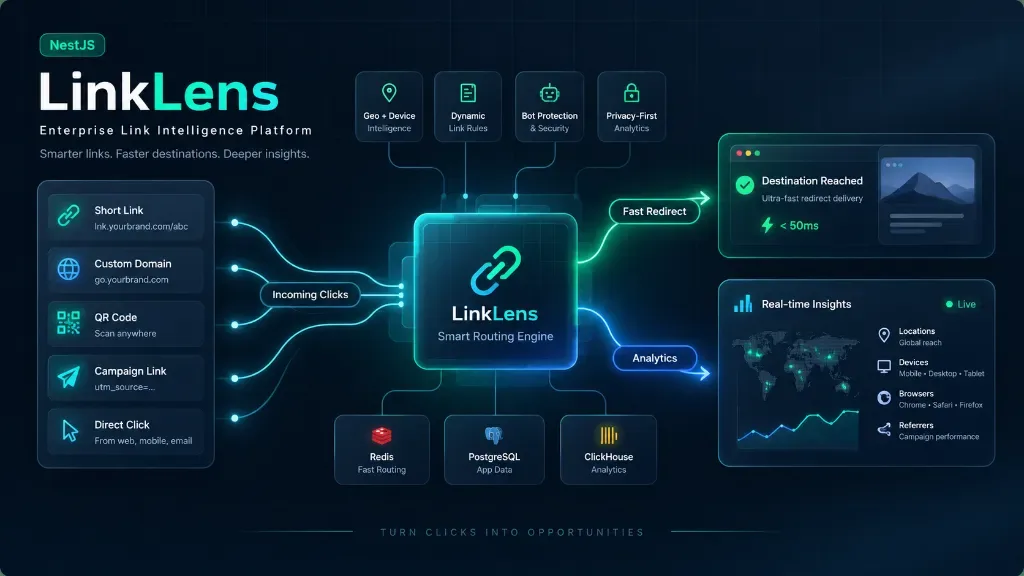
We engineered LinkLens to break this trade-off: a high-throughput, self-hosted link management and forensic intelligence platform built around sub-5ms Redis hot-path routing, asynchronous ClickHouse clickstream analytics, dynamic vector QR generation, and zero-cost self-hosted geo/device intelligence.
Here is how the architecture works and the core engineering problems it solves.
The Real-World Engineering Problems LinkLens Solves
1. Eliminating the 100ms Redirect Latency Penalty
In modern web marketing, latency directly translates to bounce rate. If a user clicks a marketing link and waits hundreds of milliseconds just for the HTTP `301/302` header, conversion drops before the target landing page even starts downloading.
LinkLens decouples the redirect path entirely from transactional databases:
Redis Hot-Path: Incoming requests resolve destination URLs directly from memory in under 5ms.
Cache Stampede Prevention: Hot-key caching with smart TTLs ensures viral links withstand massive traffic spikes without cache collapse.
Resilient Fallback: Only genuine cache misses fall back to transactional storage, instantly repopulating the hot cache.
2. Solving Analytics Table Bloat with ClickHouse Isolation
Recording every click event (timestamps, referrers, IP hashes, user agents, query parameters) in PostgreSQL or MySQL quickly results in tens of millions of rows, exploding table size and slowing down unrelated database operations.
LinkLens implements a strict two-tier data architecture:
The redirect worker emits lightweight telemetry events to an asynchronous message queue.
Clickstream events are batch-inserted into ClickHouse, a columnar analytical database engineered for billions of rows and sub-second aggregations.
Analytical queries never touch or compete with the latency-sensitive redirect engine.
3. Forensic Bot Traffic & Abuse Classification
Standard link shorteners present vanity metrics: "You got 50,000 clicks!" But in production, understanding who clicked is just as important as how many:
How much traffic originated from web scrapers, preview crawlers (Slack, WhatsApp, iMessage), and malicious click farms?
Was an unexpected traffic surge at 3:00 AM organic or an automated traffic burst?
Are malicious actors attempting redirect loops or phishing cloaking on your domains?
LinkLens provides forensic search, anomaly detection, crawler signature recognition, and tamper-evident audit logs for complete clickstream accountability.
4. Zero-Cost, Privacy-First Geo and Device Intelligence
Commercial redirect platforms routinely bill per-lookup fees for third-party geolocation and device detection APIs (MaxMind Web Services, ipinfo, etc.). Over millions of redirects, these API costs dwarf server hosting bills.
LinkLens solves this with offline, self-hosted enrichment:
Locally maintained GeoIP databases enrich country, region, city, and ASN data without making outbound network calls.
In-memory User-Agent parsing identifies operating systems, device types, and browser engines in microseconds.
Configurable IP hashing and data retention policies comply with GDPR, HIPAA, and CCPA requirements by default.
5. Resilient Physical & Dynamic QR Marketing
When links are printed on packaging, billboards, or conference materials, a broken destination URL means a ruined physical campaign.
LinkLens generates dynamic, high-resolution vector QR codes (SVG/PNG) that decouple the visual barcode from the final destination. Marketers can update target URLs, configure time-based link expirations, or redirect based on scheduled rules without reprinting physical materials.
Architectural Deep Dive: How the Pipeline Works
To achieve high concurrency and zero degradation, LinkLens separates operational traffic from analytical computation:
The Hot Redirect Path (Sub-5ms Execution)
Client Request: Traffic hits the lightweight Edge/HTTP redirect gateway.
Hot Lookup: The gateway checks the Redis in-memory cache for `slug:metadata`.
Loop & Expiry Check: Expiration dates, redirect loops, and custom domain rules are verified in memory.
Immediate Redirect: HTTP `302 Found` (or `301 Moved Permanently`) is returned to the client in milliseconds.
Async Event Emit: An asynchronous telemetry payload is dispatched to the background worker pool without delaying the HTTP response.
The Analytical & Enrichment Path
Local Enrichment: Background workers enrich the raw click event using local GeoIP files and fast User-Agent parsers.
Columnar Ingestion: Enriched events are batched and streamed into ClickHouse tables optimized for time-series aggregation.
Webhook Dispatch: If click thresholds or alert conditions are triggered, HMAC-signed webhooks are delivered with exponential backoff retries.
Enterprise Governance: Workspaces & RBAC
Large organizations require team boundaries. LinkLens includes native multi-tenancy:
Workspaces: Isolated environments for different departments, clients, or products.
Role-Based Access Control (RBAC): Granular permissions for Owner, Administrator, Manager, Analyst, and Viewer.
Custom Domain Management: Provision and route branded domains (e.g., `go.yourcompany.com`) directly to specific workspaces.
Tamper-Evident Audit Trails: Every URL update, domain configuration change, and role assignment is permanently logged.
Key Takeaways
Building a production-ready link intelligence engine is not just about URL strings—it is an exercise in latency optimization, analytical scalability, and cost efficiency:
Speed matters: Keep your redirect hot path in Redis; never block client redirects on relational database queries.
Isolate telemetry: Use columnar storage (ClickHouse) for clickstreams to protect transactional databases from table bloat.
Self-host intelligence: Eliminate external API lookup taxes with local GeoIP and device parsing.
Maintain data ownership: Keep full forensic visibility inside your own infrastructure.
LinkLens demonstrates that with the right architectural separation, teams can run enterprise-grade redirect intelligence with predictable, near-zero marginal infrastructure costs.